
Finding Alexandria Residents by Record
Alexandria has no single government household list. Choose the first record by what is already known. A street address points to the assessment search and parcel map. A legal owner or an earlier transfer points to the Circuit Court Clerk. A person from a prior era often appears first in a directory, newspaper index, cemetery volume, probate file, or census schedule. A current Alexandria residents directory search works best when each result is treated as a piece of evidence, rather than a final answer.
The City is an independent Virginia locality. An Alexandria mailing address can instead fall in Fairfax or Arlington, so confirm the jurisdiction before choosing a custodian. Property cards establish parcel information and recorded documents establish a legal transfer. Neither creates a complete roster of people at an address. The Virginia voter tool is designed for a person's own status and polling-place check, not a name-and-address directory.
- Start with the full street address in the City assessment search when a parcel is known.
- Compare the parcel's situs, mailing address, map-block-lot, and legal description before drawing a conclusion.
- Use the Clerk's grantor-grantee index for a recorded ownership trail.
- For an older person or address, consult Alexandria Library's directory, Gazette, cemetery, and map collections.
- Ask the actual custodian for an unavailable city record through the documented counter, archive, or request channel.
Alexandria Residents Records Offices
The Alexandria residents directory is spread across city and court offices, not a county department. Real Estate Assessments holds the current parcel card. The Clerk of Circuit Court holds deeds, probate material, and other court-kept records. Voter Registration & Elections routes an individual to the state status portal. The Library and City Archives support the historical trail. Each office keeps a different kind of fact, and each has a different access route.
Alexandria Clerk Land Records
520 King Street, Room 307
Alexandria, VA 22314
703-746-4044
Real Estate Assessments
100 N Pitt Street, Suite 225
Alexandria, VA 22314
703-746-4646
Voter Registration & Elections
132 North Royal Street, Suite 100
Alexandria, VA 22314
703-746-4050
For a street-wide parcel method, use the focused Alexandria street directory reference rather than assuming the records offices publish one combined street roster.
Alexandria Assessment Search Fields
The public assessment form offers address, account-number, and map-number paths. In address mode, Street Name is the required choice. Street Number and unit are optional. Leaving the number and unit blank permits a browse of the selected street, which is useful when the exact parcel number is unknown. Results lead to current assessment and sales links, while the Parcel Viewer helps place the card on the city map.
| Assessment control | How Alexandria uses it |
|---|---|
| Street Number | Optional; omit it with the unit to browse a selected street. |
| Street Name | Required normalized street choice, with directional variants where applicable. |
| Apartment or condo unit | Optional, used to narrow a multiunit parcel. |
| Account Number | Separate alternative search mode. |
| Map Number | Separate mode for a map-block-lot reference. |
The assessment landing page shows the three search modes. A parcel card may list an owner, but the owner, correspondence address, and physical situs should remain separate facts in an Alexandria residents directory search.
The City assessment search is shown here before an address is entered.
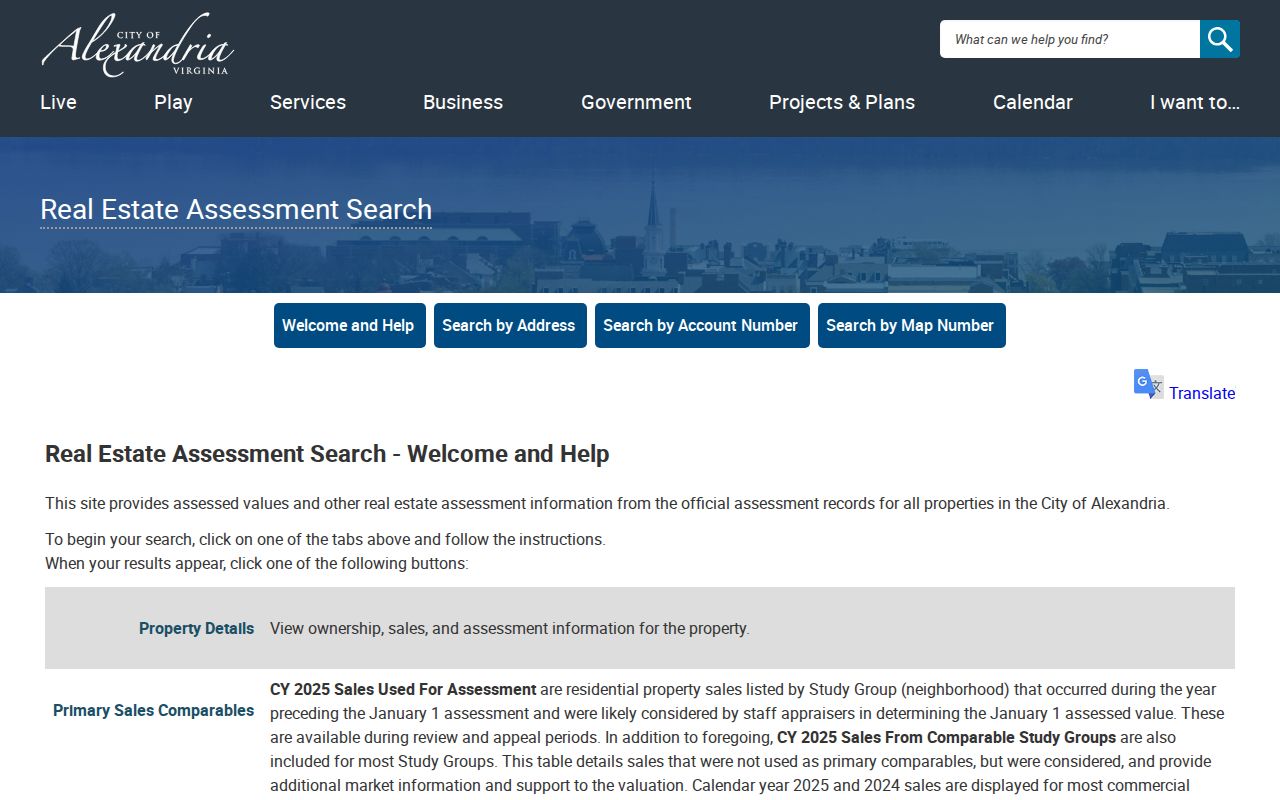
The three modes are a practical reminder that an Alexandria parcel has both a street identity and a stable account or map reference.
Alexandria Parcel Records Need Context
A parcel is the land unit used in an assessment and recorded-document system. Its card can show the account, map-block-lot, owner name, owner mailing address, situs, legal description, tax status, values, sales data, zoning, and building details. The City Hall sample at 301 King Street illustrates the distinction well: its City owner and PO Box correspondence address are not a statement about a private resident. That distinction prevents a basic but common search error.
- Roll
- A list created for a particular administrative purpose, such as the assessment roll, not a complete population list.
- Index
- A finding aid that points to a document or record entry, sometimes without displaying the underlying image.
- Parcel
- A defined piece of land tied to a map or account identifier.
- Criss-cross directory
- An address-arranged directory section that can connect a historic address to an occupant or business.
The Alexandria Parcel Viewer can connect a selected parcel to assessment details, zoning, and linked historic subdivision plats or survey plans. The City describes map boundaries as informational, so a viewer image is not survey or title proof.
Alexandria Deed Index Has Gaps
Recorded deeds are often the strongest identity check when the question is who held a legal interest in a parcel. Alexandria's Clerk points researchers to COVERS and Virginia Secure Remote Access, often called SRA. The online deed and land-record ranges are 1785 through 1801, 1821 through 1824, and 1930 to the present. That is not continuous coverage. Printed indexes, books, and microfilm available through the Clerk cover December 1782 through October 1993 and bridge much of the online gap.
Start from the current grantee or legal description, find the latest recorded instrument, then use the seller or prior reference to move backward. The Clerk's counter, public records room, mailed copy route, and SRA access are all part of the Alexandria residents directory trail. Copies are listed at $0.50 per page and certification at $2. Images can require subscriber authorization even where an index path is available.
Current Alexandria Resident Directories
Current Alexandria directory sources answer narrow questions. Assessment cards identify property ownership and official mailing information. Recorded documents name parties to an instrument. City staff contacts identify public-facing employees in an official role. Election systems have strict access rules. A directory category is useful only when its coverage matches the question being asked.
| Alexandria source | What it can establish | Custodian | Access route |
|---|---|---|---|
| Assessment search | Parcel owner, mailing address, situs, account and legal description | Real Estate Assessments | Free address, account, or map search |
| Land-record index | Parties, instrument date and property transfer trail | Circuit Court Clerk | COVERS/SRA, counter, books, microfilm |
| Voter status portal | A user's own registration status and polling place | Virginia Elections | Individual self-service only |
| City staff contacts | Official-capacity personnel contacts | City departments | Department and phone-directory materials |
| Community map | Association geography and names, not member lists | City interactive maps | Reference map and association contacts |
When a result is tied to one person rather than one parcel, compare it against another independent source using the Alexandria resident lookup method.
Alexandria Voter Checks Have Limits
The Virginia Department of Elections citizen portal lets a registrant check personal registration status and polling place. Alexandria directs voters to that portal and provides a local office fallback at 703-746-4050. It is not a public name-and-address lookup. The exact fields of the rendered form were not captured in the research, so an Alexandria residents directory should not promise a third-party name result or invent field labels.
Virginia law separates individual voter records from public-record requests. VERIS records are not available through FOIA under Va. Code §24.2-404(B). Registered-voter and voting lists are controlled by §§24.2-405 through 24.2-407 and are limited to listed recipients and purposes. A protected person may also use an alternative address in voter-related records. A blank result never proves a person did not live in Alexandria.
Note: Alexandria's elections office can help a registrant with the official status and polling-place route, while voter-file access follows separate statutory rules.
Alexandria Courts Split the Search
Court names can add a public case association, party-name variant, case number, filing date, or disposition to an identity trail. Alexandria Circuit Court, General District Court, Juvenile and Domestic Relations District Court, and the federal Alexandria Division are separate systems. The Virginia case-information hub routes users into the right division. Statewide OCIS covers adult criminal information in juvenile and domestic relations courts, general-district criminal and traffic data, and selected circuit information, but Virginia has no statewide circuit-court name search.
Use locality, party name, case number, or hearing date where the relevant court system offers that path. Juvenile, domestic-relations, sealed, expunged, adoption, and other confidential information have separate limits. The Clerk's local counter remains an access channel for Alexandria court-held records, while PACER serves federal cases. A same-name case entry is a lead, not proof of identity.
Alexandria Vital Records Use Timelines
Virginia vital records are not all open on the same schedule. Birth records become public after 100 years. Death, marriage, and divorce records become public after 25 years. The Virginia Department of Health lists births and deaths for 1853 through 1896 and from June 1912 onward, marriages from 1853 onward, and divorces from 1918 onward. More recent certified records are restricted to eligible immediate family or next of kin with identification under Va. Code §32.1-271 and related rules.
Alexandria Health Department offers local in-person and mail access, while VDH is the official state custodian. The inspected fee is $15 for a certificate or search. For historical family research, use an index, Gazette notice, cemetery record, or library compilation before assuming a current certificate is available. A public historical index and a certified record are different products with different access rules.
Historical Alexandria Residents Directories
Alexandria's historical directory shelf begins in 1791. The local run is unusually valuable because 1924 and later directories include a criss-cross address section, and the Library reports an almost continuous 1950 through 1980 run. City Archives lists directories from 1950 through 1979 with gaps. These printed volumes can place a name, address, occupation, household marker, or business in a specific edition, but an entry does not automatically establish title ownership.
Alexandria Library Local History/Special Collections also holds Gazette and newspaper material, local histories, church and cemetery resources, deed and will microfilm, maps, and school materials. The full collection and reading method belong on the Alexandria city directory page. The Library's staff and virtual or curbside service offer a useful fallback when a volume, map, or microfilm reel is not online.
Alexandria Gazette Indexes Add Endpoints
A name trail sometimes moves from a directory into an obituary, cemetery, or probate source. Alexandria Library identifies an Alexandria Gazette obituary-name compilation covering 1784 through 1915. Virginia Chronicle provides an online Gazette run from 1834 through 1923. The Library also names WPA alphabetical birth and death indexes and five tombstone-inscription volumes covering most city cemeteries. These sources can clarify a death, family connection, or period of residence without turning a historical mention into a current-location claim.
Historic cemeteries are a particularly local layer. Historic Cemeteries of Alexandria identifies fifteen historic cemeteries in Old Town, and the Library's tombstone volumes provide maps and cemetery histories. Alexandria National Cemetery and the federal gravesite locator are separate sources for veterans. Record the publication, date, page, and exact spelling so that a later probate or directory search can be checked against the original entry.
Alexandria FOIA Routes City Files
The Virginia Freedom of Information Act, Va. Code §§2.2-3700 et seq., is the route for existing City administrative records that are not otherwise available. A reasonably specific request generally receives records or a written response within five working days. If a practical response needs more time, the City may take seven additional working days after timely notice. Charges may cover actual access, search, supply, or duplication costs, and a deposit may be requested when anticipated charges exceed $200.
City Archives requests currently have a special path. The Archives & Records Center at 801 South Payne Street is appointment-only, and City-document requests currently route through the City Attorney's FOIA office. In 2026, Public Records Advisory Commission minutes reported reprocessing work and discussion of a possible public research kiosk, but that access change remained under City Attorney review. Court-kept records have a different rule: Virginia FOIA does not govern records maintained by clerks of courts of record. Use the Clerk's records channels for deeds, probate, and court files rather than a City FOIA request.
Alexandria's FOIA page shows the online, email, phone, and in-person request options.
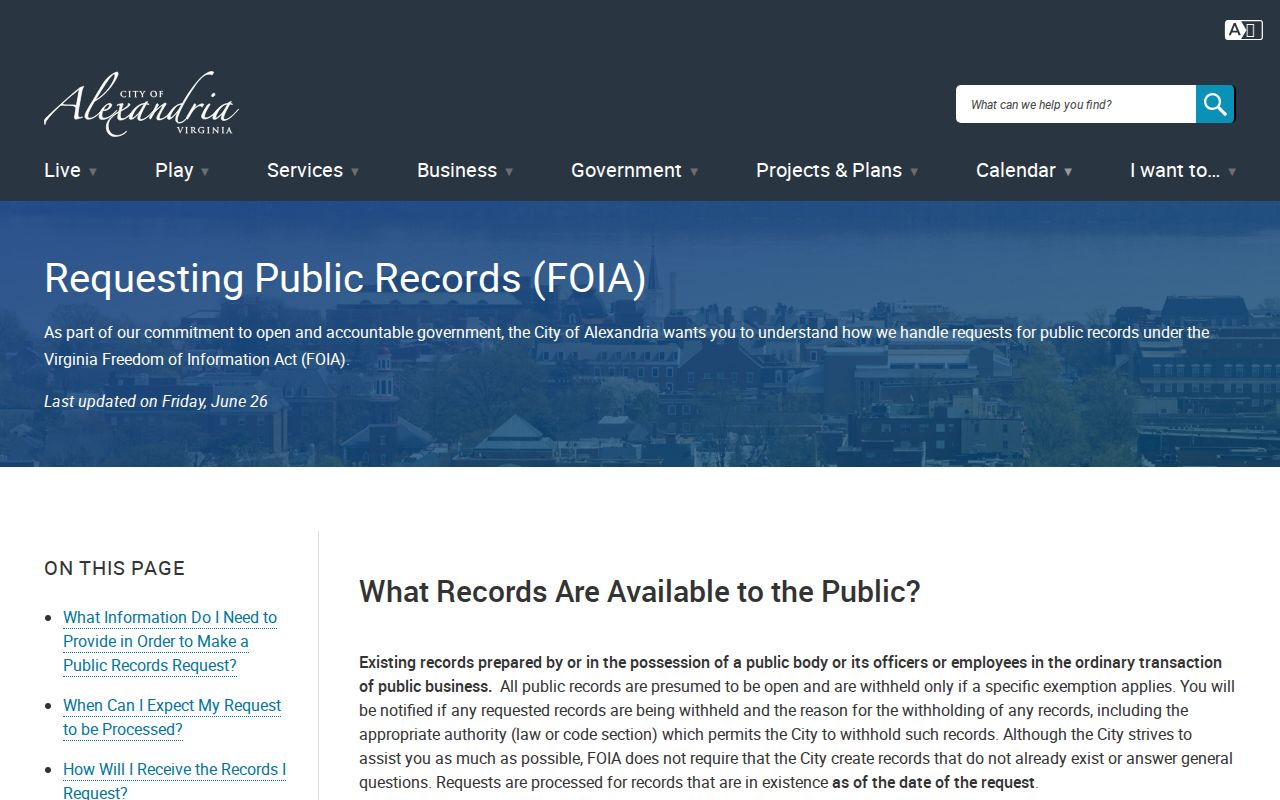
FOIA is a request route for existing City records, not a shortcut around election, vital-record, court, or protected-record rules.
Alexandria Deed Alerts Protect Names
Alexandria's Clerk now advertises VADeed Alert, a free service for city property owners. It sends an email notice when a deed, mortgage, deed of gift, or similar recorded document matches a selected name or tax map or parcel identifier. Multiple name versions and parcel references can be added. The service is a property-fraud alert, not an ownership determination, but it shows the local index's practical connection between recorded names and parcel identifiers.
Confirm any unexpected instrument with the Clerk, the recorded document, and the property account. An unsolicited offer for a deed copy or monitoring service deserves the same care. The Clerk lists official copies at $0.50 per page and certification at $2, while the official alert is free to eligible city property owners. This local Alexandria change was announced in 2026.
Alexandria Name Searches Need Caution
Official records and commercial lookup products serve different purposes. An official record identifies its custodian, scope, date, and access rule. A commercial compilation may merge stale information, same-name people, marketing data, and public-record extracts. A result should be checked against the original city, court, or state source before it is used for family reconnection, estate research, a seller check, or civic curiosity.
| Source type | Strength | Care needed |
|---|---|---|
| Official Alexandria or Virginia record | Clear custodian and record-specific access path | Scope can be narrow, historical, or restricted |
| Library or archive collection | Context, older names, maps, and directory editions | Verify edition, date, and original entry |
| Commercial compilation | May suggest a research lead | Identity matching, freshness, and removal practices vary |
Alexandria State Name Sources Stay Narrow
Custody and public-safety systems are not a general Alexandria residents directory. The Alexandria Sheriff's Office directs detention-record questions to its records and inmate-information route. The Virginia Department of Corrections locator accepts the first three letters of a first name with a full last name, or a DOC ID, and carries a daily-update notice. The State Police registry has separate public functions and legal-use limits. None of those records should be used to infer a full address history.
Virginia's DOC locator displays the name and DOC-ID entry paths described in the state resource.
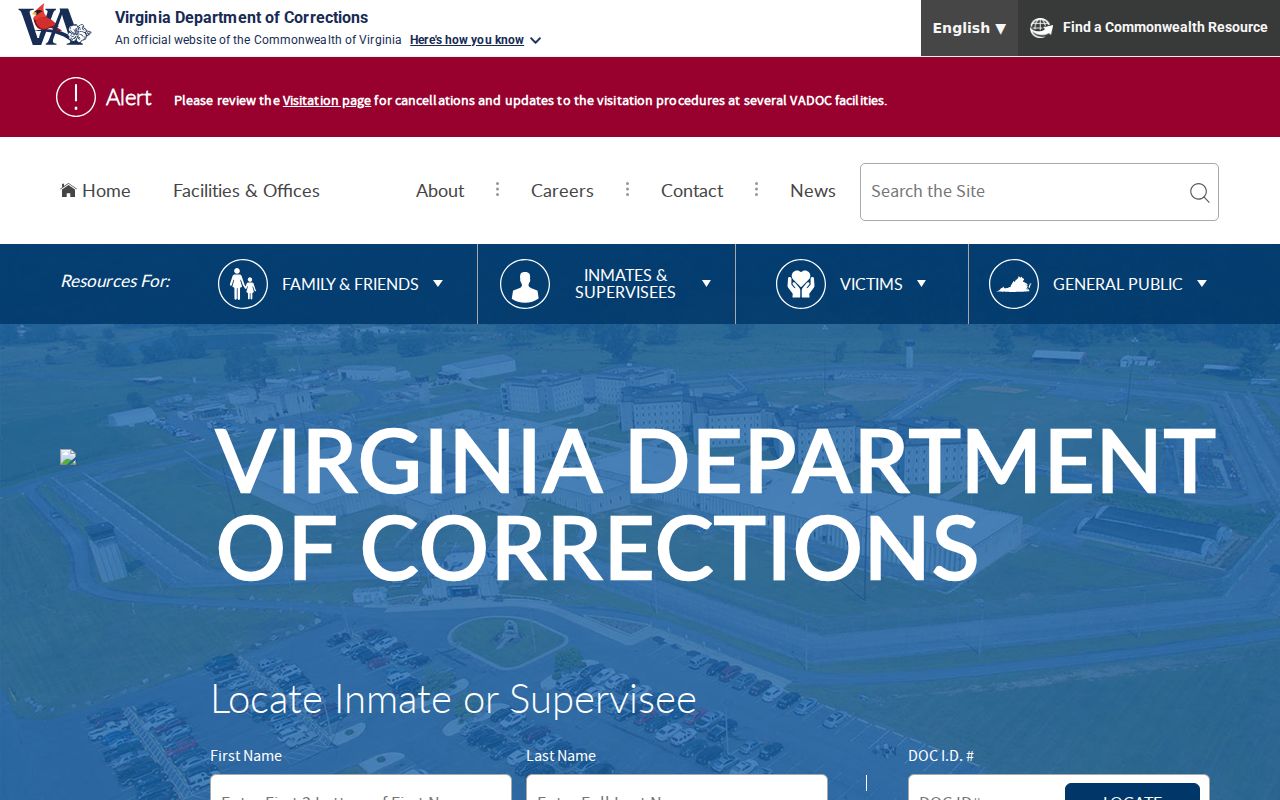
The locator's narrow search function and disclaimer show why a custody record is best treated as a current routing tool, not a household roll.
Virginia Treasury's unclaimed-property search can associate a name with money, stocks, dividends, deposits, or insurance proceeds that were reported to the state. It is free to search through vaMoneySearch, but it is not a current-address confirmation. A claimant must prove ownership, and the Treasury offers an inquiry form and phone fallback where an online claim route is not enough. Use it as a discrete name lead, then verify any identity with the appropriate record custodian.
Virginia Treasury's unclaimed-property page links the official name search and claim guidance.
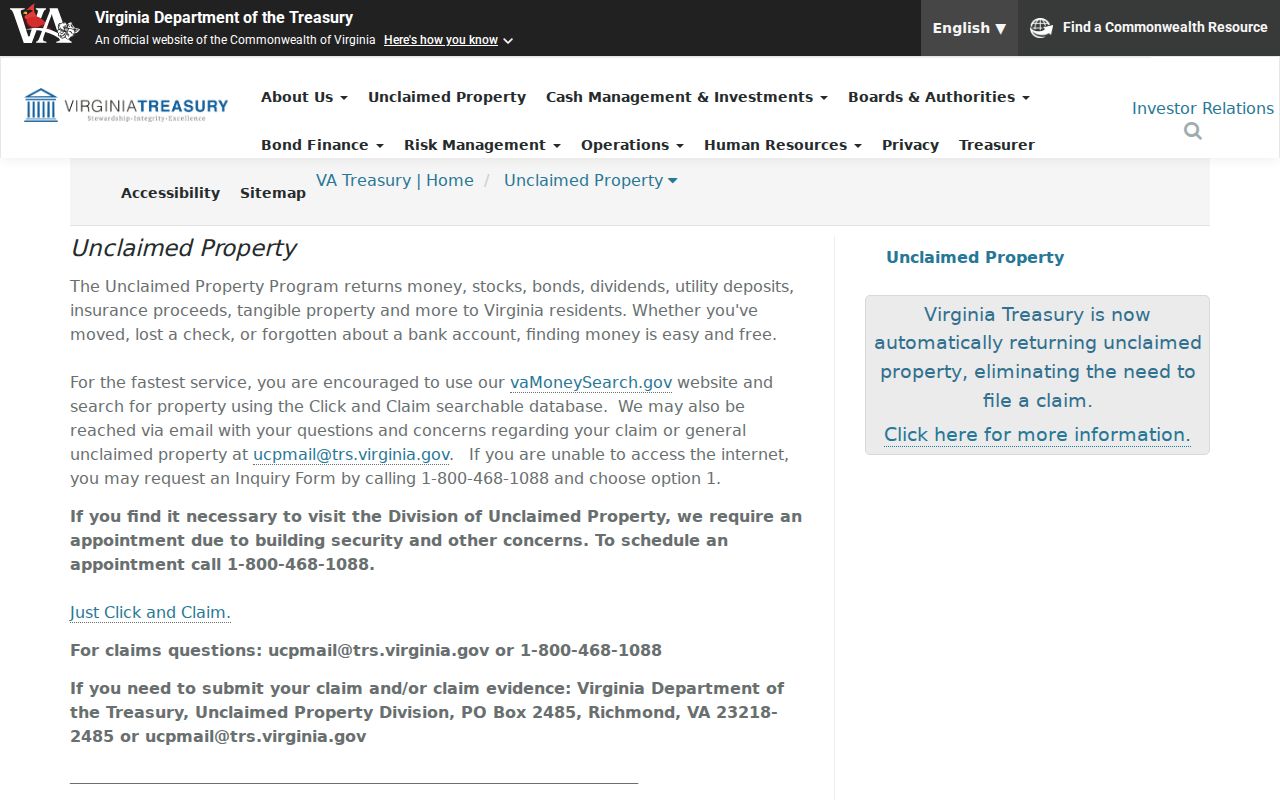
The state workflow requires evidence for a claim, so a matching name is a reason to investigate carefully, not proof that the asset belongs to a particular Alexandria person.
Alexandria ZIP Lines Change Custody
Postal identity is broader than Alexandria city jurisdiction. The City's ZIP guidance says 22302, 22304, 22311, and 22312 cross into Fairfax County, while 22206 crosses into Arlington County. It also warns that several Alexandria-mailing ZIP areas lie outside the City. A selected address should therefore be checked through USPS mailing information and the local parcel record before an Alexandria office is treated as the custodian.
The 1887 renumbering and later street-name changes add a second address problem for older research. A historic directory or map may use a prior number or street name even when the modern parcel is inside the City. For ZIP geography and municipal-boundary detail, use the Alexandria ZIP code directory after the address itself has been confirmed.